 ビール醸造のプロも愛読!ホップの魅力がわかる『THE NEW IPA』
 歴史好き必見!『ビール大全』で深掘り
 『ビールのつくりかた大事典』で醸造プロセスを学ぼう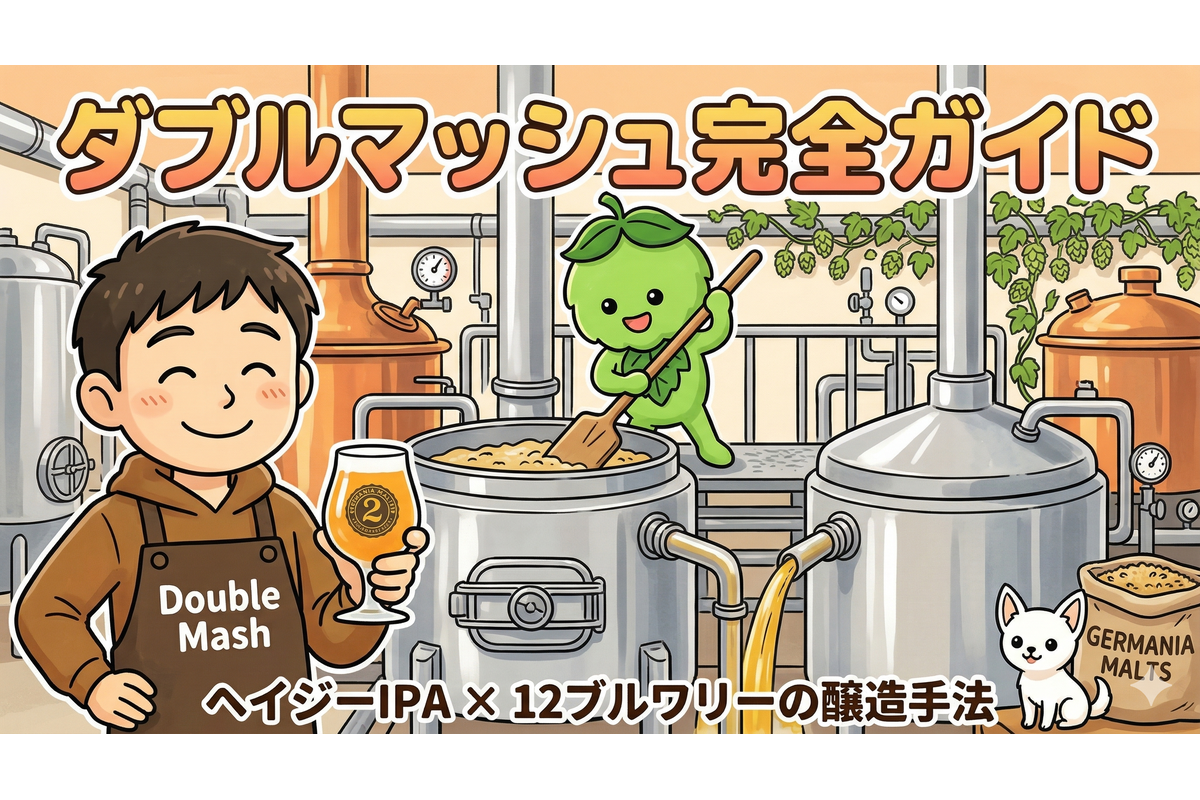

Hi, I’m Riho, a craft beer enthusiast. Today, I’m going to do a deep dive into “double mashing” — a term that any hazy IPA fan has heard at least once. We’ll compare the techniques of 12 popular breweries, including Brujos’ “2x Mash,” Fidens’ brewing methods, Tree House, and Monkish.

Double mashing is often thought of as a “magic technique that makes beer taste better,” but it’s actually a practical solution for overcoming equipment limitations, Hop! The meaning varies completely from brewery to brewery, so let me break it all down for you, Hop!
- Glossary of Terms Used in This Guide
- “Double Mashing” Doesn’t Mean Just One Thing — Three Distinct Patterns
- What Is Brujos’ “2x Mash”? — Understanding Through a Real Example
- Single Mash vs. Double Mash: Flavor Differences
- Brewing Techniques of 12 Top Hazy IPA Breweries
- Fidens Brewing — Artistry from a Tiny System
- Other Half Brewing — The Oat King
- Tree House Brewing — Pioneer of the Low-Temperature Whirlpool
- Trillium Brewing — Low-Temperature Mash + Warm Dry Hop
- Monkish Brewing — Brewing That “Listens” to Each Hop’s Character
- The Alchemist — The Legend of Heady Topper
- Equilibrium Brewery — Scientific Brewing by an MIT PhD
- Parish Brewing — Pushing Citra to the Extreme
- Other Notable Breweries
- Why Double Mashing Becomes Essential for Small Breweries
- The Cost of Double Mashing: Time, Money, and Tank Occupancy
- The Science of Hop Aroma and Alcohol Content
- Thiols and Hop Oils Are Not the Same Thing
- Don’t Confuse Double Mashing with Mash Hopping
- Summary: Double Mashing Is Not a Flavor-Defining Factor
- Frequently Asked Questions (FAQ)
Glossary of Terms Used in This Guide
Brewing terminology can be hard to follow if you’re not familiar with it, so let’s define the key terms upfront.
| Term | Definition |
|---|---|
| Mash (Saccharification) | The process of soaking crushed malt in hot water to convert the grain’s starches into sugars — creating the “sweetness base” for beer |
| Wort | The sweet liquid obtained from mashing. After boiling with hops and fermenting with yeast, it becomes beer |
| Mash Tun | The vessel where mashing takes place — essentially a large pot for hot water and grain |
| Kettle (Brew Kettle) | The vessel used to boil the wort and add hops |
| Fermenter | The tank where yeast is added to ferment the beer |
| OG (Original Gravity) | A measurement of how much sugar is dissolved in the wort before fermentation. Higher OG means higher potential alcohol content |
| ABV | Alcohol By Volume. Can be calculated with our ABV Calculator |
| Dry Hopping | Adding hops after the boil (during or after fermentation) to impart aroma rather than bitterness. DDH means double dry hopping — adding hops twice |
| Flaked Oats / Wheat | Heat-processed and rolled oat or wheat flakes. High in protein, they add body and haze to beer |
| bbl (Barrel) | A unit of brewing volume. 1 barrel = approx. 117 liters = about 31 US gallons |
Now that you know the terminology, the rest of this article will be much easier to follow, Hop! Let’s start with the “three different meanings” of double mashing, Hop!
“Double Mashing” Doesn’t Mean Just One Thing — Three Distinct Patterns
The term “double mash” refers to completely different techniques depending on the brewery and context. There are broadly three patterns.
Pattern 1: Double Batch (Mashing Twice and Combining the Wort)
This involves splitting the grain into two separate mashes, mashing each batch normally, then combining the wort in the kettle before boiling, Hop. The second mash also uses plain water — that’s the key point. The goal is either “to fill the fermenter” or “the grain won’t fit in the mash tun in one go,” Hop!
In craft breweries, fermenters are typically 2-4 times larger than the mash tun, so double batching is a routine practice even for standard-gravity beers. On the ProBrewer forum, there are accounts like “We double batch every time to fill our 10 bbl fermenter from a 5 bbl mash tun.” This is the most common meaning of “double mashing.”
Pattern 2: Reiterated Mash (Mashing New Grain with Existing Wort)
This is a completely different technique, Hop! Instead of water, you use the wort from the first mash to mash a second batch of grain. In other words, you’re adding fresh grain to liquid that already contains dissolved sugars, extracting even more sugar from the new grain, Hop!
This method allows you to increase the gravity (concentration) without increasing the volume. The technique was systematized by Chris Colby in the December 2007 issue of Brew Your Own magazine and is also called “sequential mashing” or “parti-gyle.”
Tombstone Brewing Company used this method to brew a 15.5% ABV Imperial Stout — an 18-hour brew day using 660 pounds of Vermont maple syrup, as documented on their official blog.
So while Pattern 1 “increases volume,” Pattern 2 “increases concentration without changing volume.” Understanding this distinction is absolutely crucial.
Pattern 3: Adjunct Double Mash (American Lager Context)
In brewing textbooks, “double mash” can also refer to performing a “cereal mash” — boiling adjuncts like corn or rice separately from the main malt mash, then combining the two. This technique is used in American light lagers like Budweiser but is unrelated to hazy IPA.
What Is Brujos’ “2x Mash”? — Understanding Through a Real Example
When Brujos Brewing labels a beer as “2x Mash,” it’s on their quadruple IPAs around 12% ABV, Hop. Examples include “La Dama Caries” (12% ABV, Citra + Eclipse) and “Sr. Apostata” (12.1% ABV), Hop!
Brujos took over Hammer & Stitch Brewing’s 15 bbl system in 2024 and opened in Portland. Their regular IPAs and double IPAs don’t carry the “2x Mash” label — it’s only used on quadruple IPAs above 10% ABV.
To achieve a gravity as extreme as 12%, simply splitting into two batches isn’t enough. It likely involves elements of both Pattern 1 (grain won’t fit in one mash) and Pattern 2 (re-mashing with existing wort to boost concentration).
Brujos’ “2x Mash, 2x DH” means “mashed twice, dry hopped twice.” It’s basically telling you they used a massive amount of both grain and hops — a seriously rich beer.
Single Mash vs. Double Mash: Flavor Differences
To get straight to the point: double mashing itself has almost no direct impact on flavor, Hop. That said, it can indirectly produce a few differences, Hop.
| Single Mash | Pattern 1 (Double Batch) | Pattern 2 (Reiterated) | |
|---|---|---|---|
| Purpose | Standard brewing | Increase volume (fill the fermenter) | Increase concentration (high ABV) |
| Effect on ABV | Baseline | No change (same recipe x2) | Significantly higher |
| Flavor Difference | Baseline | Virtually none | Thicker body, more residual sweetness |
| Brew Efficiency | Normal (~70%) | About the same | Significantly lower (50-65%) |
Pattern 1 produces beer that tastes virtually identical to a single mash. Since you’re just repeating the same recipe twice and combining the wort, the final product shows almost no difference.
Pattern 2 does change the flavor. Mashing new grain with wort that already contains sugar produces more unfermentable dextrins, resulting in a thicker body and more residual sweetness. The higher osmotic stress on yeast also tends to increase fusel alcohols and esters.
Brewing Techniques of 12 Top Hazy IPA Breweries
Here’s the main event! I’ve researched how the world’s top 12 hazy IPA breweries actually brew their beer. Let me share what I found.
The key takeaway is that Brujos is the only brewery we can confirm officially uses reiterated mashing (Pattern 2), Hop. Most breweries achieve their signature flavors through entirely different factors, Hop!
| Brewery | Location | System Size | Grain Bill | Dry Hop Method | Secret Weapon |
|---|---|---|---|---|---|
| Fidens | Albany, NY | 7 bbl | — | Post-fermentation DH | Hop selection + O2 management |
| Brujos | Portland, OR | 15 bbl | — | 2x DH (high ABV only) | 2x Mash (10%+ only) |
| Other Half | Brooklyn, NY | Multiple locations | 50%+ oats | DDH/TDH standard | Extreme oat ratio + lactose |
| Tree House | Charlton, MA | 60 bbl | Debated* | Low-temp whirlpool (42°C) | Water chemistry + hop saturation |
| Trillium | Canton, MA | 30-50 bbl | 20% wheat | 90% late/DH additions | Low-temp mash (149°F) + warm DH |
| Monkish | Torrance, CA | 15 bbl | Oats | Post-fermentation only | Technique to let each hop’s character shine |
| The Alchemist | Stowe, VT | 15 bbl x4 | Pearl Malt base | Single large charge, 4-5 days | Conan yeast + no kettle hops |
| Equilibrium | Middletown, NY | 20 bbl | Variable (incl. 100% 2-Row) | ~3 lbs/bbl + mathematical model | MIT water chemistry PhD’s scientific approach |
| Parish | Broussard, LA | — | Undisclosed | DDH Ghost: 8+ lbs/bbl Citra | Extreme Citra hopping rate |
| The Veil | Richmond, VA | 15 bbl | Wheat-based | 4+ lbs/bbl | Wheat base + coolship |
| Foam Brewers | Burlington, VT | 7 bbl | Local oats/wheat | — | Terroir (locally-sourced grain) |
| Hill Farmstead | Greensboro, VT | 15 bbl | Simple (malt + caramel) | — | Elegance + limited production |
* Whether Tree House uses flaked grains in their commercial beers is debated. Some sources attribute the haze and body to process factors (water chemistry, yeast, hop volume) rather than adjuncts.
Fidens Brewing — Artistry from a Tiny System
Fidens launched in 2019 in Colonie, NY on a 4-barrel system — incredibly small. They’ve since expanded to 7 barrels and opened a second location in Albany’s Warehouse District, Hop.
What defines Fidens’ flavor isn’t double mashing — it’s these elements:
- Hand-selecting hops at the source: Carefully curating Citra, Galaxy, Nelson Sauvin, and more
- Dry hopping after fermentation completes: “Soft crashing” to 60°F, then adding hops in two stages over two days — producing a cleaner, more hop-forward profile
- Meticulous water chemistry adjustments and rigorous dissolved oxygen control
- Mash temperature at 150-155°F; for triple IPAs, they mash lower for a drier finish
Co-founder Steve Parker has since moved to the operations side, and Anthony Dana now serves as head brewer (since around 2022). In their collaboration with Sapwood Cellars (“3S4MP”), they experimented with Omega Yeast’s thiol-liberating yeast Cosmic Punch.
Other Half Brewing — The Oat King
Other Half was founded in Brooklyn in 2014 and has since expanded to 8+ locations including Manhattan, Buffalo, Philadelphia, and Washington D.C. — growing into a mid-to-large-scale operation, Hop.
The secret to Other Half’s flavor:
- Extremely high oat ratios: In “Dream in Green,” over 50% of the grain bill is oats — the key to the creamy, thick mouthfeel of the Daydream series
- Lactose: The Oat Cream IPA series adds small amounts of unfermentable milk sugar to boost sweetness and body
- English yeast: Wyeast 1318 London Ale III delivers fruity esters and stable haze
- Heavy, multi-stage dry hopping as standard practice
Tree House Brewing — Pioneer of the Low-Temperature Whirlpool
Tree House operates a 60-barrel German-built brewhouse — a large-scale operation. They produce over 40,000 barrels per year, making them one of the largest breweries in Massachusetts, Hop.
Tree House’s most notable technique is their whirlpool at just 42°C (108°F). While standard whirlpool temperatures run 75-85°C, this ultra-low temperature prevents volatile hop aroma compounds from evaporating, allowing more fragrance to remain in the beer.
Their water chemistry targets approximately 200 ppm chloride and 100 ppm sulfate (a 2:1 ratio) for a soft mouthfeel. Mash temperature is 154-156°F for 60 minutes.
Trillium Brewing — Low-Temperature Mash + Warm Dry Hop
Trillium co-founder JC Tetreault mashes many of their beers at 149-150°F — a notably low mash temperature. This increases fermentability, yielding a drier finish that lets hop aroma shine through.
Trillium’s signature move is using 90% of their hops as late additions or dry hops, Hop. Moreover, Tetreault has said that as they progressively increased dry hop temperatures, “the beer’s aroma and flavor improved, and the appearance got crazier and crazier,” Hop!
Monkish Brewing — Brewing That “Listens” to Each Hop’s Character
Monkish’s Henry Nguyen originally specialized in Belgian styles and even had a sign that read “No MSG, No IPA.” Then in 2016, he released his first IPA and became the West Coast leader in hazy IPAs.
Monkish’s defining characteristic is dry hopping only after fermentation is complete. Nguyen has stated that “If you dry hop too early, you get a muddled hop soup.” He describes the Galaxy + Citra combination as “magical” and pursues clean flavor expression where each hop’s individual character is discernible.
The Alchemist — The Legend of Heady Topper
The Alchemist’s John Kimmich was pioneering unfiltered, hop-forward DIPAs long before the hazy IPA craze took off, Hop! Let’s look at the secrets behind Heady Topper (8% ABV), Hop!
- Thomas Fawcett Pearl Malt as the base (distinctive bready character)
- No hops added during the boil — bitterness comes solely from CO2 hop extract
- A single massive dry hop charge for 4-5 days. Kimmich has said, “When I see ‘9 pounds per barrel!’ — that’s just absurd”
- The legendary Conan yeast (VPB1188) — producing apricot and tropical fruit esters
- Four 15 bbl batches blended into a 60 bbl tank — a textbook example of double batching (Pattern 1)
Equilibrium Brewery — Scientific Brewing by an MIT PhD
Co-founder Pete Oates holds a PhD in water chemistry from MIT. He originally studied Hudson River remediation and “reversed” that expertise to apply it to brewing.
Their hop addition rate is approximately 3 lbs/bbl, with a mathematical model to predict the outcomes of process changes. In “Fractal Universe,” they used a minimalist 100% 2-Row grain bill to isolate hop variables in a controlled experiment.
Parish Brewing — Pushing Citra to the Extreme
Parish Brewing’s “Ghost in the Machine” uses over 8 lbs/bbl of Citra in the DDH version — one of the most aggressive dry hop rates in any commercial beer, Hop!
Andrew Godley conducted temperature experiments (70°F, 60°F, 50°F, 38°F) comparing Cascade hop extraction. He found that warmer temperatures produce grapefruit-peel-like aromas, while colder temperatures preserve the raw hop character. His philosophy: “This is how you make hop juice. Let the yeast do the work.”
Other Notable Breweries
The Veil (Richmond) is known for their wheat-based Master Shredder. They also own a 15 bbl coolship, pursuing both hazy IPAs and spontaneous fermentation. Foam Brewers (Burlington) operates a tiny 7 bbl system with a terroir-driven focus on locally-sourced Vermont grain. Hill Farmstead (Greensboro) is where Shaun Hill has been named “Best in the World” by RateBeer multiple years running, pursuing simplicity in grain bills and elegance in flavor.
Why Double Mashing Becomes Essential for Small Breweries
So far I’ve explained that it’s “not a flavor technique but an equipment workaround.” But here’s the thing: when a small brewery makes hazy IPA, double mashing is practically unavoidable, Hop! Let me explain exactly why, Hop.
Hazy IPAs Require Massive Grain Bills
To achieve the signature haze, creamy mouthfeel, and full body of a hazy IPA, 20-50% of the grain bill may consist of flaked oats and flaked wheat. These adjuncts are bulkier than standard malt and absorb more water, causing the total mash volume to swell significantly.
In other words, even for the same ABV, a hazy IPA requires much more mash tun capacity than a standard IPA.
A Real-World Example: The 7-Barrel Brewery Scenario
| Equipment | Capacity |
|---|---|
| Mash Tun | 7 barrels (~820 liters) |
| Kettle | 7 barrels |
| Fermenter | 15 barrels (~1,760 liters) |
If this brewery wants to produce 15 barrels of an 8.5% ABV double hazy IPA, they need approximately 350-400 kg of grain, but a single mash can only handle about 180-200 kg. The solution: double mashing — running two mash cycles and combining the wort in the kettle.
This is exactly how Fidens was able to produce 8.5% double IPAs on their 4-barrel system — double batching (Pattern 1) made it possible, Hop. The Alchemist also runs four 15 bbl batches to fill a 60 bbl tank, and Foam Brewers brews on 7 bbl and transfers to fermenters at a separate facility, Hop.
The “Stuck Mash” Problem
Hazy IPA recipes with high proportions of oats and wheat tend to create a thick, porridge-like mash that can stop flowing — a “stuck mash.” By splitting the grain across two mashes with double batching, you reduce the grain load per cycle and mitigate this risk.
The Cost of Double Mashing: Time, Money, and Tank Occupancy
Double mashing comes with clear drawbacks. It’s not a technique brewers choose because they want to — it’s something they do because they can’t brew the beer otherwise.
- Nearly doubles the brew day — Adds 2-2.5+ hours including prep and cleanup. Even starting at 4 AM, the boil may not finish until the afternoon
- Ties up tank time — For a small brewery with a single mash tun, one batch takes an entire day
- Increases labor costs — Temperature monitoring, grain loading, and spent grain removal must all be done twice by hand
- Lowers brew efficiency — Typical 70% efficiency drops to 60-65%, raising raw material costs
In short, double mashing is like a “tax” that small breweries pay to produce high-gravity beer, Hop. Upgrading to larger equipment eliminates the need, but that requires significant capital investment, Hop.
The Science of Hop Aroma and Alcohol Content
Why High-ABV Beers Taste More Fruity
This gets a bit scientific, but it’s an important point, Hop. There’s a solid reason why high-ABV hazy IPAs taste more fruity than lower-ABV ones, Hop.
Alcohol acts as a solvent for hop oils. Hop essential oils (linalool, geraniol, myrcene, and others) are poorly soluble in water but dissolve readily in ethanol.
Research by Cocuzza et al. (2022, BrewingScience) compared dry hop extraction across four ABV levels (0.5%, 2.5%, 5.5%, 10.5%) and confirmed that monoterpene and sesquiterpene transfer increases with higher alcohol content. Brewers Journal has also reported that “at 5-8% ABV, sufficient ethanol exists for meaningful myrcene extraction from dry hops.”
Furthermore, high-gravity, high-protein beers have greater viscosity, helping volatile aroma compounds remain suspended in the liquid. Research by Castro & Ross (2013, ASBC Journal) found that beers high in protein and carbohydrates show “notably stronger dry hop flavor,” though conversely, “volatile compounds bind to proteins, reducing the aroma that rises from the glass.”
Thiols and Hop Oils Are Not the Same Thing
This is an area where people often get confused, so let me clarify it properly, Hop!
| Hop Oils (Essential Oils) | Thiols | |
|---|---|---|
| Key Compounds | Linalool, geraniol, myrcene, and approx. 1,000 other compounds | 3MH (grapefruit), 3MHA (passionfruit/guava), 4MMP (blackcurrant) * Note: “Thiol” and the hop variety “Chinook” sound similar but are completely different things |
| Aroma Profile | Floral, citrus, resinous, woody | Tropical fruit (extremely potent) |
| Relationship with ABV | Higher ABV = greater solubility | Independent of ABV |
| What Determines the Amount | Hop variety, dosing rate, DH conditions | Yeast strain (presence of beta-lyase enzyme) |
If you want to maximize thiol levels, the most effective approach isn’t raising the ABV — it’s using a thiol-liberating yeast, Hop. With strains like Berkeley Yeast’s “Tropics” or Omega Yeast’s “Cosmic Punch,” thiol concentrations that are normally below 100 ng/L skyrocket to 2-10 μg/L (a 20-100x increase), Hop!
Don’t Confuse Double Mashing with Mash Hopping
“Double mashing” and “mash hopping” sound similar but are completely different techniques — don’t mix them up!
Mash hopping is the practice of adding hops during the mash stage itself. Cerebral Brewing mash-hops every hazy IPA batch, adding 0.5 pounds of Cascade per barrel to the mash.
The effects of mash hopping include:
- Thiol precursor extraction: Bound thiol precursors from hops dissolve into the wort during the mash, and when combined with thiol-liberating yeast, they amplify tropical aromas
- Metal ion removal: Hop acids bind with iron ions, reducing iron content in beer by up to 30% and slowing oxidation (Scott Janish, The New IPA)
However, Berkeley Yeast’s latest guidance states that mash hopping is “not necessarily required” and that hops like Saaz, Mittelfruh, and Tettnang can contribute “vegetal, spicy off-flavors.” They suggest that barley malt itself contains sufficient thiol precursors.
Summary: Double Mashing Is Not a Flavor-Defining Factor
| Factor | Impact on Flavor | Explanation |
|---|---|---|
| Double Mashing | Minor | May slightly increase body. Primarily an equipment workaround |
| Hop Variety & Quantity | Very High | The single biggest driver of juicy, tropical aroma |
| Dry Hop Timing & Frequency | High | Flavor differs between mid-fermentation vs. post-fermentation additions |
| Grain Bill Composition | High | Determines mouthfeel thickness, creaminess, and haze |
| Yeast Selection | High | Controls the quantity and quality of fruity aromas |
| Water Chemistry | Moderate | Chloride-to-sulfate ratio shapes the overall balance |
| Mash Temperature | Moderate | Lower (65°C) for dry finish, higher (68°C) for full body |
| Oxygen Management | High | Oxidation rapidly degrades hop aroma |
Brujos highlights double mashing to showcase the richness of their ultra-high-ABV beers. Fidens relies on double batching out of necessity with their small system, but their real secret is hop selection and oxygen control. Other Half carves its own path with extreme oat ratios and lactose. Tree House revolutionized with their low-temperature whirlpool. Monkish lets each hop’s character shine through post-fermentation dry hopping. Every brewery has its own philosophy, Hop!
“Uses double mashing” does not equal “tastes better.” Each brewery pursues the best possible flavor through methods that suit their equipment and philosophy. That’s the key message of this article. I hope you’ll try beers from these breweries and taste the differences for yourself!
If you’d like to design your own recipe, our Recipe Builder lets you simulate ABV, IBU, and SRM. You can also check out the Hazy IPA style guidelines in our Beer Style Guide.
Frequently Asked Questions (FAQ)
Q. Are “double mash” and “double batch” the same thing?
Strictly speaking, no. Double batching (Pattern 1) involves mashing the same recipe twice and combining the wort to increase volume. Reiterated mashing (Pattern 2) uses the first mash’s wort instead of water to mash new grain, increasing concentration. Both are sometimes called “double mashing,” so context matters.
Q. Does double mashing improve the flavor of beer?
With double batching (Pattern 1), the resulting beer tastes virtually identical to a single mash. With reiterated mashing (Pattern 2), the body becomes thicker and more residual sweetness remains — but this is a side effect, not an improvement. The real flavor drivers of hazy IPA are hop variety and quantity, yeast, water chemistry, and dry hop timing.
Q. Does the fruitiness of a hazy IPA relate to alcohol content?
Yes, indirectly. Alcohol acts as a solvent for hop oils (essential oils), so higher ABV means more aroma compounds dissolve from dry hops into the beer. However, the key compounds responsible for tropical aromas — thiols — are determined not by ABV but by the yeast strain (specifically, thiol-liberating yeast).
Q. Which major hazy IPA breweries use double mashing?
Of the 12 breweries surveyed, Brujos Brewing is the only one confirmed to officially use reiterated mashing (Pattern 2), labeling it “2x Mash” on their quadruple IPAs above 10% ABV. The Alchemist routinely practices double batching (Pattern 1), combining four batches into one tank. Small-system breweries like Tree House, Fidens, and Foam also commonly double batch.
Q. What is the difference between mash hopping and double mashing?
They are completely different techniques. Double mashing involves running the saccharification process twice — done for equipment-related reasons. Mash hopping is adding hops during the mash to extract thiol precursors and remove metal ions. Despite the similar names, they have different purposes and effects.

 Twitterで新着情報を受け取る
クラフトビール好きにおすすめ